
You've looked at your own site more times than any customer ever will. You know every page. So when it isn't producing calls or quote requests, you go looking for what's wrong the same way you'd look at anything you own: you look at how it looks. The fonts feel dated. The photos feel generic. Maybe it just needs a refresh.
That's usually the wrong diagnosis.
"Looks good" and "makes money" are different problems
"Looks good" and "makes money" are not the same engineering problem, and they don't share a fix. A site can be visually current (modern fonts, clean layout, decent photography) and still fail to convert a single visitor into a call. A site can also look a little rough around the edges and still close deals, if it does the one thing that actually matters: get the right information in front of the right person, in the right order, with an obvious next step.
That second thing is structure. Not "UX" in the vague, unfalsifiable sense the word usually gets used in. Something much more concrete:
- What does a visitor see first, and does it answer the question they actually came with?
- Where does your proof sit (the thing that makes a stranger trust you), relative to the point where you're asking them to act?
- How many steps, clicks, or scrolls stand between "interested" and "contacted you"?
None of that is about typography or color palette. All of it is about sequencing. A "make it prettier" redesign doesn't touch any of it, because it was never a visual problem to begin with.
This isn't a pattern unique to one client. IMD Business School raised their landing page conversion rate from 3.91% to 6.38%, a 63% jump, just by moving video testimonials and an "About Us" section higher on the page. No redesign. (Case study, Apexure) Apexure hasn't published a sample size or test duration for that number, so treat it as directional, not proof on its own.
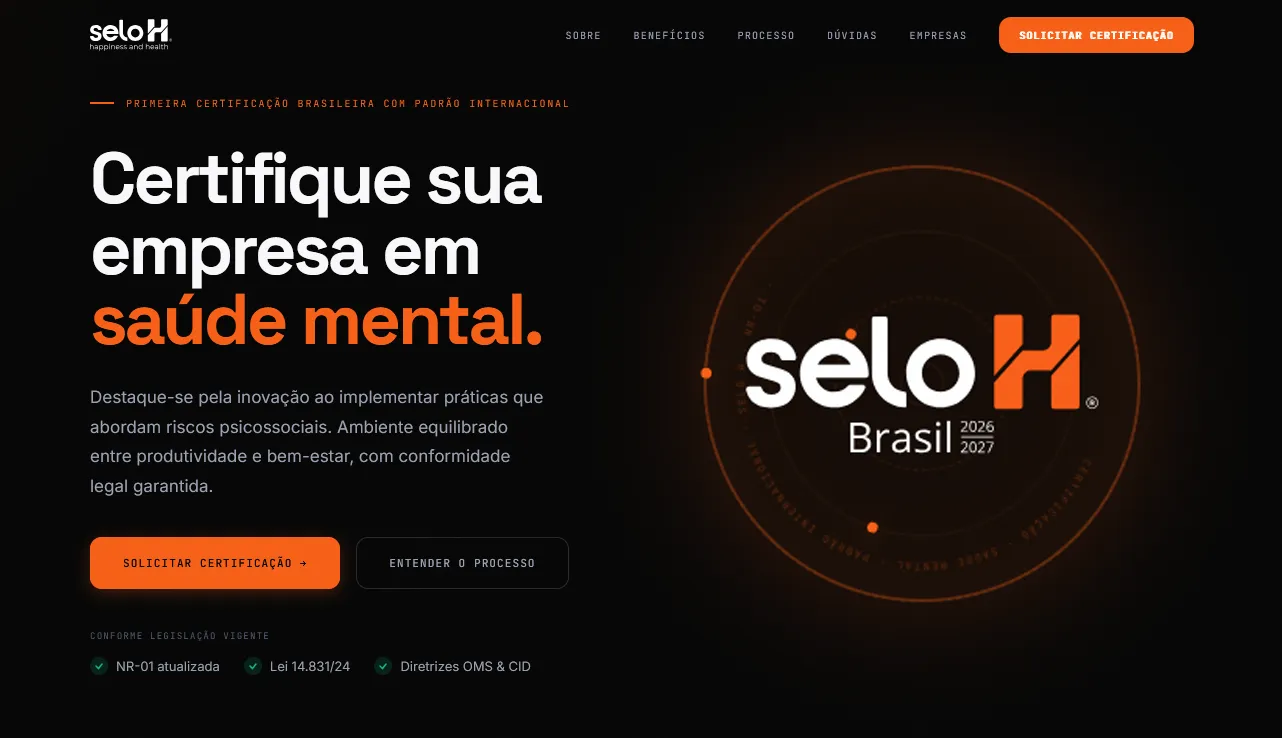
One real example closer to home: Selo H, a workplace mental-health certification with genuine legal and scientific credibility, had no clear primary action and buried its strongest proof under generic description. Reordering that same information, with no new visual design, changed what happened next.
 Before
After
Before
After
Fig. 1: Drag to compare the old seloh.org against the rebuild. Same information, reordered.
Full case study →
Why you can't see this on your own site
You already know your own product. You already believe the case for it. So when you look at your own homepage, your brain fills in the gaps a stranger's won't. You don't notice the proof is missing or buried, because you already know it's true.
That's why "we don't start designing until we know what's broken" isn't a slogan. It's a sequencing rule. Design decisions made before the structural diagnosis just make the wrong structure look nicer.
Check your own site right now
Open your homepage on your phone, the way an actual visitor would. Time how long it takes a total stranger to find two things: what you actually do, and how to contact you. If it takes longer than a few seconds, or if the answer requires scrolling past several sections of description first, that's your order problem, and it's fixable without a redesign.